
AI tools for small business growth are no longer optional—these solutions drive efficiency, customer experience, and revenue even on limited budgets.
Businesses worldwide are leveraging AI to streamline operations, gain marketing insights, and reduce overhead costs.
For small businesses, AI offers the potential to elevate customer experiences and automate critical tasks like inventory management and sales forecasting.
Achieving this efficiency level is easier than you might think—just a few blogs and some homework away.
In this blog post, we’ve curated key information to help you understand how you can benefit from AI tools for business and how you can start right now.
Let’s get started.
Table of Contents
Key Takeaways
- Future backbone of operations: AI tools for business are set to become the backbone of operations, enhancing both business processes and customer experiences.
- Cost savings and growth for small businesses: Small businesses can significantly cut overhead costs, drive efficiency, and unlock new growth areas with AI.
- Competitive edge: AI tools are essential for staying competitive and innovative in business.
- CRM automation: AI-powered CRM tools automate lead scoring and customer segmentation, boosting the effectiveness of customer relationship management.
- Sales empowerment: AI assistants for sales enable teams to prioritize leads, optimize follow-up strategies through data analysis, and increase conversion rates, driving revenue growth.
- HR automation: AI-powered HR tools like Beamery, SeekOut, HR Signal, and ObviouslyAI automate candidate sourcing, screening, and matching.
- Data-driven decisions: Integrating AI tools helps small businesses gain valuable insights and make data-driven decisions.
Check out the EngageBay CRM Guide here
Understanding AI Tools for Business
The core aim of artificial intelligence for business is to enable machines to learn and reason like humans, performing critical tasks such as lead generation, fraud detection, customer care, and quality control within commercial operations by including AI tools that help small businesses grow, scale CRM, automate marketing, and improve sales performance.
AI also extends to marketing and content creation, aiding in keyword identification, content strategy, performance analysis, and improvement.
These AI-powered tools use machine learning to achieve specific tasks, making business processes more efficient.
With AI tools available for every industry, from sales and operations to marketing and customer support, businesses are eager to incorporate AI for its numerous benefits.
AI automation reduces the need for resources, cutting overhead costs and allowing businesses to focus on core goals and scalability.
This leads to higher efficiency in both time and effort—a win-win for any business.
AI in Business 2026 Snapshot: Gartner predicts 40% of enterprise apps will have task-specific AI agents by 2026 — up dramatically from ~5% in 2025, signalling a shift from automation to autonomous business workflows.
What to Look for in 2026: AI Tools That Drive Growth, Revenue & Efficiency
In 2026, businesses aren’t just adopting AI — they’re strategically investing in AI tools that create measurable impact. Whether you’re a small business owner or a business leader at a growing company, the right AI toolkit can be the difference between incremental improvements and exponential success.
Here’s how to evaluate and prioritize AI tools that truly drive growth, revenue, and operational efficiency — with a focus on where long-term value is created in 2026.
1. Best AI Tools for Small Business Growth
Small businesses have unique needs: limited budgets, lean teams, and an urgency to scale fast. The best AI tools for small business growth in 2026 are those that democratize advanced capabilities without complexity.
What to look for:
-
Simple onboarding: Drag-and-drop interfaces, easy setup, and proactive support so small teams can go live fast.
-
All-in-one capabilities: Tools that bundle multiple functions — like CRM, email automation, and analytics — help small businesses grow without stacking costs.
-
Affordable pricing plans: Tiered options that scale with business needs, often with usage-based billing or low entry costs.
-
Revenue acceleration: AI features that directly improve lead generation, conversion, and retention.
Examples of value:
AI that automatically segments leads, predicts best follow-up times, and recommends personalized messaging — helping small teams increase conversions without added headcount.
2. Best AI Tools for Marketing, CRM & Sales in 2026
For businesses focused on revenue and customer experience, the intersection of marketing, CRM & sales is where AI delivers the most strategic advantage.
In 2026, the best AI tools for marketing, CRM & sales share a few key characteristics:
Intelligent Customer Insights:
AI that analyzes customer behavior across channels — web, email, chat, and purchase history — to generate deep insights. These insights help teams tailor messaging, improve conversion rates, and proactively retain customers.
Automated Lead & Pipeline Management:
AI tools that score leads based on engagement patterns, forecast deal outcomes, and prompt timely follow-ups boost sales efficiency and close more deals.
Personalized Customer Journeys:
From dynamically optimized email campaigns to smart chatbots that tailor responses based on buyer intent, advanced AI enables one-to-one personalization at scale.
Cross-Functional Integration:
Top tools connect marketing automation with CRM and sales dashboards so teams share unified data and reduce operational friction.
Key features to prioritize:
-
Predictive sales forecasting
-
AI-driven segmentation and personalization
-
Automated content generation for campaigns
-
Smart engagement triggers (like abandoned cart follow-ups)
These capabilities help businesses—from SMBs to enterprise teams—drive higher revenue with more efficient workflows.
3. AI Adoption Trends Business Leaders Should Know
AI adoption isn’t just about tools — it’s about strategic transformation. In 2026, business leaders need clarity on the trends that define how AI is reshaping competition and execution:
a) AI as a Growth Multiplier
Business leaders are prioritizing AI investments that directly influence revenue outcomes — like dynamic pricing, churn prediction models, and AI-optimized digital advertising.
b) Cross-Department AI Collaboration
Rather than siloed AI pilots in engineering or IT, successful companies are integrating AI across marketing, sales, operations, and customer success. This accelerates ROI because insights are shared, not trapped in isolated tools.
c) Ethical & Responsible AI Use
Companies that lead with transparency around their use of AI — particularly in customer interactions — build trust and credibility. This includes clear opt-in policies and privacy-safe data models.
d) Upskilling Human Talent
As AI handles routine tasks, organizations that invest in upskilling teams (data literacy, strategic decision-making, creative automation oversight) get the most value from these tools.
e) Data-Driven Decision Culture
AI adoption trends in 2026 show that leaders who cultivate a data-driven mindset outperform peers. They rely on AI-generated insights to test hypotheses, monitor performance, and adjust strategies in real time.
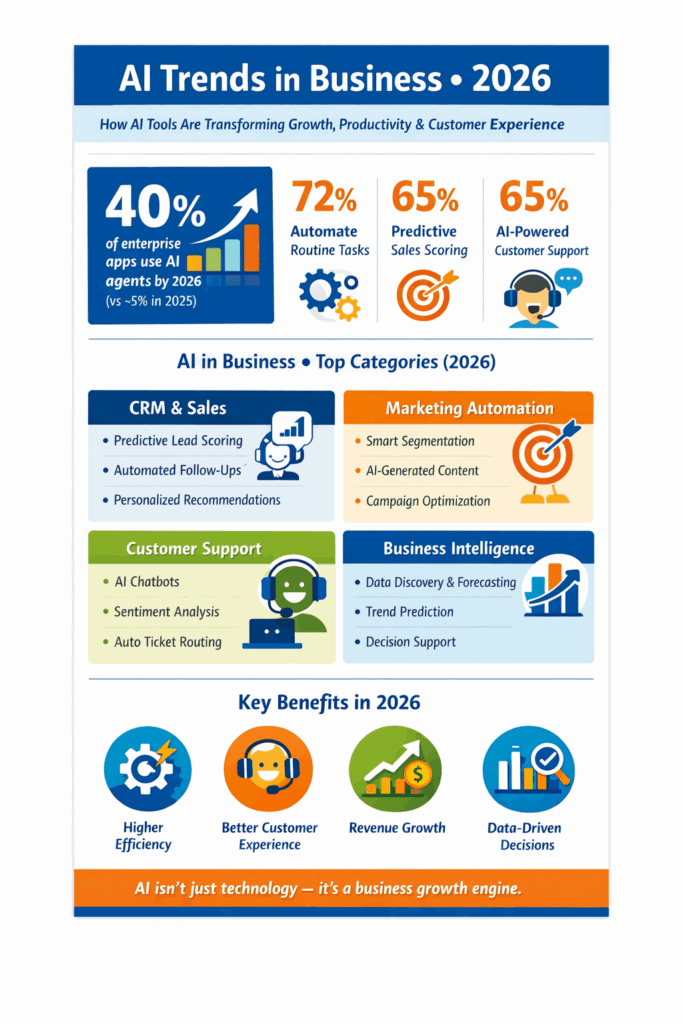
40% enterprise apps use AI agents by 2026 (vs ~5% in 2025)
Takeaway
As you evaluate AI tools this year, think beyond features and price. Look for solutions that:
-
Empower small business growth with scalability and simplicity.
-
Offer best-in-class AI for marketing, CRM & sales in 2026 with real impact on conversions and revenue.
-
Align with AI adoption trends business leaders should know — including cross-functional integration, ethical use, and a focus on measurable business results.
The right mix of tools and strategy sets the stage for your business to not just compete — but lead — in an AI-driven future.
Know how to implement AI in Email Marketing
Categories of AI Tools for Small Businesses
It’s time to explore the various AI tools available for businesses. AI software comes in many forms, each designed to meet specific industry and operational needs.
Let’s categorize them on a broader spectrum.
Customer Relationship Management (CRM) Tools
CRM tools utilize machine learning algorithms to analyze customer data and streamline company interactions.
Customer relations are critical for any business, and AI empowers companies to personalize interactions, anticipate customer needs, and provide tailored solutions.
CRM tools automate tasks like lead scoring and customer segmentation, enhancing the effectiveness of customer relationship management.
Tools like Salesforce, Mailchimp, HubSpot, and EngageBay are designed to help you manage your customer relations more effectively.
Marketing Automation AI Tools for Business
Marketing automation tools can help you in content marketing, search engine optimization, creating engaging visuals with tools like an AI Product Demo Video Maker, email marketing, optimizing social media posts, and more.
With the growing use of AI-generated content in marketing, businesses should consider implementing an AI checker to verify the authenticity of their materials and ensure compliance with platform guidelines that may flag automated content.
Next, we have AI programs for marketing. These innovative tools help you strategize your content and analyze your performance.
Marketers creating visual assets can also benefit from an ai cartoon generator to produce engaging, stylized graphics for campaigns and social content.
Using data analytics and predictive modeling, they create personalized marketing campaigns.
Incorporating text-to-speech (TTS) into these campaigns can increase accessibility and expand reach to audio-preferred audiences.
Popular tools include EngageBay, ActiveCampaign, HubSpot, Klaviyo, Drip, Envato AI Tools, Omnisend and Distribution AI.
These tools excel in natural language processing (NLP) and intent analysis, optimizing your content for search engines.
Marketing automation tools assist with content marketing, SEO, content creation, email marketing, social media optimization, and more.
Sales and Lead Generation Tools
AI does in seconds what the human mind may take hours to do.
It takes care of time-consuming tasks that majorly affect your sales and lead generation process, such as studying your customers’ historical data and behavioral patterns within seconds.
Doing that, it successfully conducts predictive analysis and identifies potential leads.
As per a McKinsey report, 70% of businesses using AI in sales claim that it has improved their marketing and sales revenue. And how did that happen?
By automating lead qualification processes and getting real-time insights, the sales intelligence tools have empowered sales teams to prioritize leads, optimize follow-up strategies, and increase conversion rates, ultimately driving revenue growth.
Examples of AI-powered sales and lead management tools include EngageBay, HubSpot, LinkedIn Sales Navigator, and Lusha.
Financial Management Tools
AI excels at handling repetitive tasks that are crucial to your business processes.
AI-enabled financial management solutions streamline accounting by automating data entry and reconciliation tasks.
Leading tools like Vena Insights, Domo, and Trullion help businesses manage their finances efficiently.
AI finance management tools use advanced algorithms to analyze financial data, detect anomalies, forecast trends, and provide actionable insights for informed decision-making.
Additionally, these tools reduce manual errors and improve accuracy, enhancing overall financial efficiency and compliance.
Human Resources Tools
Human Resources is one of the most AI-integrated areas in business operations.
HR specialists use tools like AI recruitment software to provide decision-makers with vital information.
HR AI software like Beamery, SeekOut, HR Signal, Marlee, Peoplebox.ai and ObviouslyAI automate candidate sourcing, screening, and matching.
Natural language processing (NLP) algorithms analyze resumes and job descriptions to identify ideal candidates.
Additionally, AI enhances HR operations by improving onboarding procedures, utilizing metaverse settings for immersive training, and more.
Operations Management Tools
Another area that AI has revolutionized is operations management, enhancing business processes like workflow automation, inventory management, logistics, and supply chain optimization.
AI tools for operations management automate inventory tracking, predict demand fluctuations, and optimize supply chain routes, ensuring seamless operations.
Tools like LeewayHertz specialize in AI-driven inventory management, streamlining processes, and reducing costs.
By leveraging AI in logistics, businesses can enhance route planning, minimize delivery times, and mitigate risks.
The result is heightened efficiency, reduced overheads, and improved customer satisfaction, making AI integration indispensable for modern businesses navigating complex operational landscapes.
Enterprise AI Infrastructure & Platform Tools
For businesses requiring high-performance AI capabilities at enterprise scale, AI infrastructure platforms provide the computational foundation needed to deploy advanced AI models securely and efficiently across the organization.
These platforms serve as the backbone for AI-powered business applications, enabling companies to run complex AI workloads like large language models, predictive analytics, and real-time decision-making systems without the typical infrastructure overhead and energy costs.
SambaNova Systems offers a purpose-built enterprise-scale AI platform that serves as “the technology backbone for the next generation of AI computing.”
SambaNova’s platform delivers exceptional performance, with models like DeepSeek-R1 achieving up to 20 tokens/second, while their SambaRack systems consume an average of 10 kWh when running large models like Llama 4 Maverick, making it significantly more energy-efficient than traditional GPU-based solutions.
SambaNova supports deployment in cloud, on-premises, or air-gapped environments, ensuring businesses maintain complete control over their data and models.
Their flagship Samba-1 model is a one trillion parameter generative AI system that “rivals GPT-4” but is designed specifically for enterprise deployment with complete data privacy.
Other notable enterprise AI infrastructure providers include NVIDIA Enterprise AI, Google Cloud AI Platform, and Microsoft Azure AI, each offering different approaches to scaling AI across business operations.
These platforms are designed for mid-to-large enterprises that need to process large volumes of data, run multiple AI models simultaneously, and maintain strict security and compliance requirements while achieving superior performance and cost efficiency compared to traditional computing approaches.
Not ready to build or manage your own AI stack? Many small and mid-sized teams start with cloud-delivered AI as a Service (AIaaS), which provides prebuilt models, APIs, and managed MLOps so you can pilot use cases quickly without heavy infrastructure.
This guide explains how to evaluate real capabilities vs. hype, plan integrations, estimate ROI, and choose between AIaaS and managed services for your organization.
Use it to scope a first project like automated meeting summaries, calendar orchestration, or workflow agents and set the skills, security, and governance you’ll need as you scale.
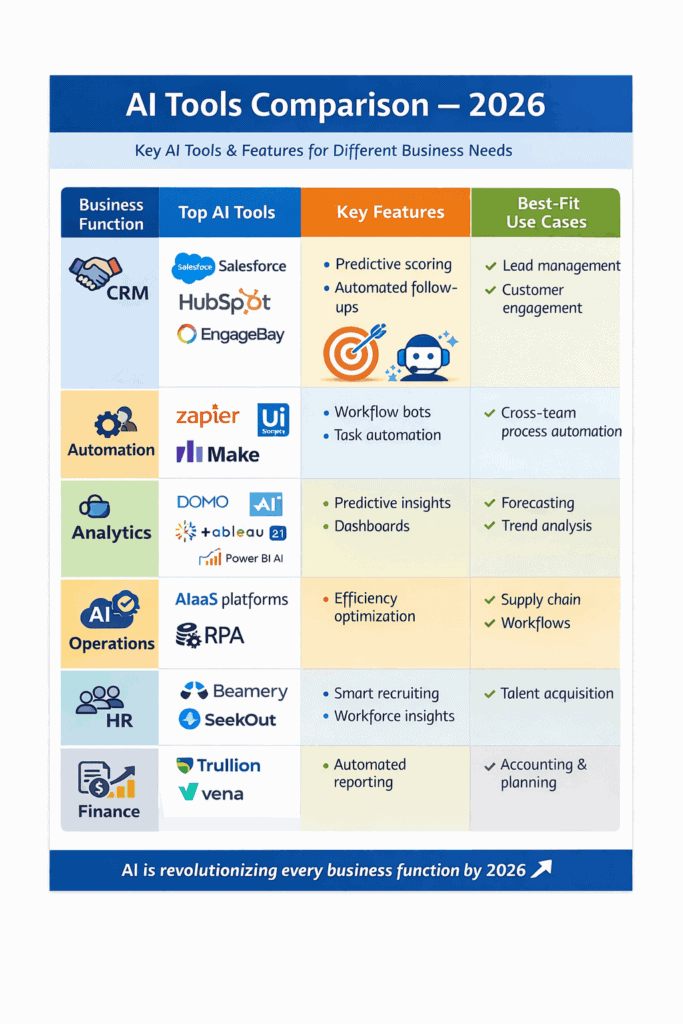
Top AI Tools by Business Use Case (2026)
| Function / Use Case | AI Tool(s) | Why It Matters in 2026 |
|---|---|---|
| CRM & Customer Engagement | Salesforce, HubSpot, EngageBay | Automates customer scoring, pipeline insights, and personalized engagement across sales and support. |
| Marketing Automation & Campaign Optimization | ActiveCampaign, Klaviyo, Omnisend, Brevo | Enables AI-driven segmentation, predictive targeting, and automated multi-channel campaigns. |
| Sales & Lead Generation | LinkedIn Sales Navigator, Lusha, Seamless.AI, Salesforge | Uses AI to identify high-intent prospects, prioritize leads, and automate outbound workflows. |
| Customer Support & CX | Zendesk AI, Freshdesk AI, Intercom | Improves response times with AI-powered ticket routing, chatbots, and sentiment analysis. |
| Financial Management & Forecasting | Domo, Vena, Trullion | Automates financial reporting and delivers predictive insights for budgeting and revenue planning. |
| HR & Talent Acquisition | Beamery, SeekOut, Peoplebox.ai | Accelerates candidate sourcing, screening, and workforce analytics with intelligent automation. |
| Operations & Workflow Automation | UiPath, Zapier, AIaaS platforms | Streamlines repetitive processes, reduces operational costs, and scales automation across teams. |
| Interactive CX & Lead Qualification | involve.me | Creates AI-assisted interactive funnels to capture, qualify, and route leads more effectively. |
See the benefits of advanced automation with AI-Sales CRM
Why AI Tools Matter for Business in 2026
In 2026, AI tools aren’t just conveniences — they’ve become strategic assets that shape how businesses operate, compete, and grow, often through targeted AI development services that solve actual business problems.
Across industries and company sizes, AI is driving a fundamental shift: from manual execution to intelligent automation, from gut-feeling decisions to data-backed insights, and from reactive operations to proactive strategy.
At their core, AI tools help businesses automate routine work, freeing teams from repetitive tasks like data entry, scheduling, and basic customer responses.
This isn’t about replacing people — it’s about unlocking human potential. When AI takes care of the mundane, teams can focus on creativity, relationship building, and high-value problem solving.
Beyond efficiency, AI tools provide predictive intelligence. Advanced models analyze patterns in customer behavior, market trends, product performance, and buying cycles.
That means businesses can anticipate demand, personalize experiences at scale, and make smarter investment decisions — before competitors do.
AI also powers better customer interactions. From real-time chatbots that resolve queries instantly to sentiment analysis that lets support teams address issues before they escalate, AI helps companies deliver consistency and responsiveness at every touchpoint.
In a world where customer expectations are constantly rising, this leads directly to stronger loyalty and higher revenues.
Moreover, AI fosters measurable business impact. Whether it’s reducing operating costs, increasing conversion rates, accelerating lead scoring, or improving campaign ROI, the outcomes are tangible.
Leaders can now quantify the value of technology investments with hard data — and optimize performance in near real time.
In short, in 2026 AI tools matter because they are no longer optional enhancements — they are core drivers of growth, resilience, and competitive advantage.
The companies that embrace AI as part of their strategic roadmap aren’t just more efficient; they are better positioned to adapt, innovate, and win in a rapidly evolving market.
How to Choose the Right AI Tool for Your Business
Selecting the ideal AI tools for business requires careful consideration of several factors. Let’s see what they are:
Consider initial and running costs
When choosing AI-powered tools for your business, it’s essential to consider their financial implications.
Consider the cost of purchasing, deploying, and maintaining the AI program.
Evaluate the potential benefits it can offer your company to determine the possible return on investment (ROI).
To make an informed decision, weigh the pros and cons of integrating AI software into your business operations.
Check for scalability
Another crucial factor to consider is the scalability of the AI tools. Ensure the AI tool can grow with your company.
Evaluate the tool’s flexibility to handle increasing data volumes, user loads, and operational complexities.
Maintain compatibility with your existing systems to prevent unnecessary disruptions.
Think about security and privacy
Consider the security and privacy implications of employing AI technology.
Examine the tool’s data management policies, encryption techniques, regulatory compliance (e.g., GDPR), and LLM security measures to prevent data leaks and protect sensitive information during AI interactions, along with any potential risks related to its deployment.
Evaluate the potential return on investment (ROI) by assessing how the AI tool enhances efficiency, reduces costs, and improves outcomes.
Look for tangible metrics such as increased productivity, reduced errors, and enhanced customer satisfaction.
To mitigate risks, implement AI in specific areas that deliver immediate benefits.
As your business grows, gradually scale up the use of AI tools, leveraging insights and feedback to optimize performance and maximize their impact on your operations.
By following these guidelines, you can effectively harness the power of AI to drive innovation and success in your business.
Meet EngageBay AI: Smarter Automation
Examples of Successful AI Implementation in Small Businesses
Adopting AI is crucial for companies to stay competitive and avoid falling behind.
Many corporations have implemented AI in their sectors and achieved impressive investment returns.
Fashion industry
For example, fast-fashion retailers like H&M and Zara use artificial intelligence to manage inventory levels, analyze historical data, forecast trends, and predict customer demand.
H&M employs over 200 data scientists and AI systems to stay ahead of the curve.
Their AI systems gather data on fashion trends by scraping content from blogs and search engines.
This data influences everything from purchase timing and quantities to in-store placement, ensuring they remain competitive and responsive to market demands.
Banking sector
Transitioning to the banking sector, this industry is transforming using AI.
AI empowers bankers by improving access to crucial information about the bank’s range of products, including features, benefits, terms and conditions, pricing, and more.
This shift is a key part of the larger movement in bank technology trends.
For instance, an IBM client, a bank, found that its IBM Watson-managed chatbots correctly answered 55% of all customer inquiries, requests, and messages.
This allowed the remaining 45% to be promptly forwarded to human bankers.
Health sector
Furthermore, addressing health and hunger issues involves early-stage diagnosis and optimal food delivery.
Researchers at the University of Heidelberg and Stanford University have developed a disease-detection AI program that outperforms experienced dermatologists by evaluating images of skin blemishes and determining if they are carcinogenic.
Additionally, AI-enabled wearable devices can diagnose patients with early indicators of diabetes with 85% accuracy by analyzing heart-rate sensor data.
If made affordable, these devices could benefit over 400 million individuals worldwide who suffer from the condition.
According to a McKinsey survey, 63% of respondents reported revenue growth in the business divisions where their companies employed an AI tool.
Check out EngageBay’s Free AI Chatbot for Sales & Support
Conclusion
Artificial intelligence has indelibly transformed the business landscape, prompting companies to integrate AI tools into their operations eagerly.
AI simulates human intelligence, solving problems by analyzing data and recognizing patterns. Businesses are harnessing their machine learning algorithms to streamline processes, enhance customer relations, and boost their ROIs.
So, why wait? Conduct due diligence, identify the AI tool you need, compare the best options, and find the perfect AI solution for your business.
Embrace the future of innovation and efficiency today.
EngageBay is an all-in-one marketing, sales, and customer support software for small businesses, startups, and solopreneurs. You get email marketing, marketing automation, landing page and email templates, segmentation and personalization, sales pipelines, live chat, and more.
Sign up for free with EngageBay or book a demo with our experts.
An AI tool is a software program that employs AI algorithms to do specified tasks and solve issues. AI solutions may be used to automate operations, analyze data, and improve decision-making across various industries, including healthcare, finance, marketing, and education.
AI tools can help small businesses increase productivity, cut costs, provide better customer service, and expand their options. Small companies can implement artificial intelligence (AI) solutions to help with accounting, customer service, marketing, security, and recruiting.
Not all. There’s some truth to AI tools being expensive, but that’s just because of how comprehensive they are and how they help your business grow.
ClickUp. Abbot. BrightBot. Zigpoll. Tiledesk. Yuma AI.
Yes, AI tools can help you streamline your marketing efforts by optimizing, creating, and editing your content, analyzing performance results, predicting the market, and more.
Integrating AI into current systems entails identifying areas for improvement, gathering data, selecting algorithms, creating models, integrating, testing, monitoring, teaching users, and building a feedback loop to ensure continual progress.
Consider scalability, return on investments, integration with other software, cost, efficiency, and other metrics to see if you’re choosing the right AI tool for your business.
Fundamentals for ensuring data security in AI systems include encryption, Data Loss Prevention (DLP), Data classification, Tokenization, data masking, data-level access control, AI model robustness, and secure multi-party computation.
No. Artificial Intelligence is meant to complement human intelligence rather than to replace it.
Businesses can face many challenges related to data quality and availability, integration with existing systems, lack of expertise, cost, and ethical and legal considerations.
AI tools reduce manual work, improve decision-making, and boost efficiency by automating tasks, improving forecasting, personalizing outreach, and accelerating customer support.
AI automates data entry, lead scoring, and follow-ups while delivering real-time insights that help teams prioritize actions and close deals faster.

